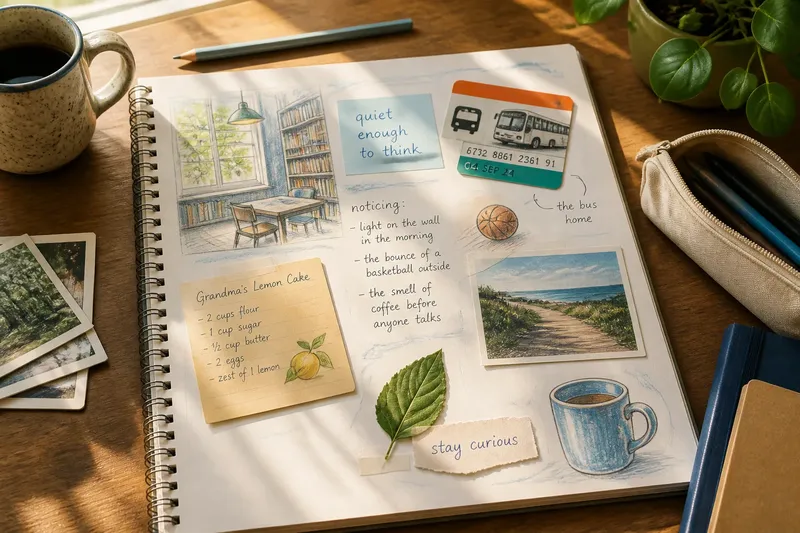
The Family Recipe as a Memory in Motion
A family recipe can hold remembered tastes and stories without staying fixed; learn how small adaptations keep its history legible across generations.
The most common mistake with a family recipe is treating its oldest version as the only authentic one. That can turn a living dish into a transcription exercise, and leave out the cooks whose substitutions, preferences, and circumstances carried it forward. A family recipe is better understood as memory in motion: a record of taste and story that changes when another person makes it.
What does a recipe remember?
A recipe records more than ingredients and instructions. It can hold the flavor someone expects at a holiday table, the smell of onions softening in a pan, or a remembered instruction to stop adding flour when the dough “feels right.” Those details connect a dish to a person and a particular kind of attention.
The written version may be much less vivid. A card might say “add milk as needed” or list an ingredient without an amount. Such gaps are not necessarily errors. They may reflect a cook who had made the dish often enough to judge it by touch, or a recipe copied for someone who already knew the routine.
That does not mean every omission should be preserved as a mystery. It means the recipe has two kinds of content: the instructions that help someone cook, and the traces that show how the dish was remembered. A useful copy can make the instructions clearer while keeping the traces visible.
How did a family recipe become a shared memory?
Recipes travel through ordinary acts: someone watches from a kitchen chair, gets handed a spoon, takes a card home, or remembers a dish well enough to recreate it without one. With each transfer, the recipe can gain a note or lose a detail. A person may replace an ingredient that is hard to find, scale the dish for a different gathering, or adjust a seasoning to suit the people eating it.
These changes often tell a small history of family life. A handwritten note about using canned fruit may point to convenience; a version without nuts may reflect a guest’s needs; an extra pinch of spice may mark one cook’s preference. The recipe does not need to explain the entire circumstance. A brief note can keep the change intelligible without turning dinner into an oral examination.
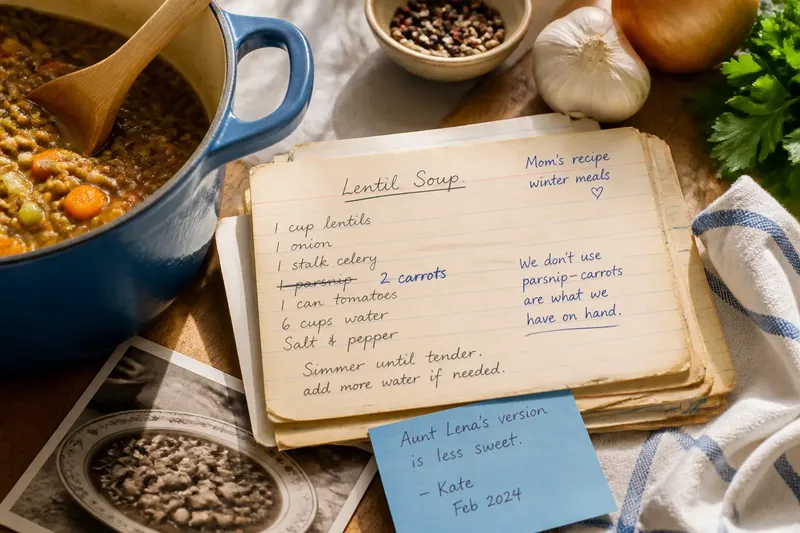
Say you inherit a card for a lentil soup that calls for a vegetable your household rarely buys. You substitute carrots, write that change beside the original ingredient, and add a note that the soup stays in your family’s winter meals. The next cook can see both the inherited direction and the reason the dish still belongs on the table.
When does an adaptation still feel like the same recipe?
There is no universal boundary. One family may recognize a dish by its texture, another by a particular spice, and another by the person who always served it at a certain gathering. A recipe can remain recognizable even when ingredients shift, if its defining qualities are still present to the people who care about it.
It helps to distinguish a change in method from a change in meaning. Replacing a pan or adjusting the cooking time may leave the remembered taste largely intact. Replacing a central ingredient may create a dish that deserves its own name, while still being connected to the earlier one. Naming the difference is not a verdict; it is useful information for whoever cooks next.
A margin note can hold that distinction plainly: “This version is less sweet than Aunt Lena’s,” or “We use beans instead of meat now.” The wording does not need to settle which version is correct. It lets memory remain specific rather than flattening several cooks into a single imagined original.
What details are worth keeping?
When you copy or share a recipe, include details that help another person recognize both the dish and its history. A phone photo of the original card can sit beside a clean, readable transcription in a shared document or a family recipe folder. Keep the source note short and concrete; “copied from Dad’s blue binder” says more than a vague claim of tradition.
- Preserve the source wording: keep a photo or faithful transcription before editing unclear directions.
- Mark changes visibly: distinguish a later substitution from the ingredient written on the old card.
- Record sensory cues: note a texture, color, smell, or taste that signals the cook is on track.
- Attach a person or occasion: identify who made the version, or when the family usually served it.
- Leave room for disagreement: if relatives remember different versions, note both rather than forcing one account into place.
These details make a recipe more usable without pretending that every remembered instruction can be made exact. “Cook until tender” may need a clearer cue for a beginner, but the original phrase can remain alongside it. The new wording helps someone cook; the old wording preserves the voice of the source.
What questions do people ask about family recipes?
Should I keep the original recipe unchanged?
Keep a copy of the source if it matters to you, but a working version can include clarifications and adaptations. Showing what changed makes the relationship between versions easier to follow.
How can I record a recipe with no exact measurements?
Write down the quantities you use and include the cues that guide your judgment, such as how thick a batter should look. If the source cook used a familiar cup or spoon, note that context rather than silently converting it into a precision the recipe never had.
What if relatives remember the dish differently?
Keep each account attached to the person who remembers it. Different versions may reflect different cooks or moments, not a failure to recall one definitive recipe.
Can a changed dish still count as a family recipe?
It can, especially if the connection is named: who passed it on, what was adapted, and what people still recognize. The word “family” describes a line of use and meaning, not a promise that the ingredient list never moved.
How can the recipe keep moving?
Share the recipe in a form someone can actually use: a legible card, a printed page, or a document that can be copied without losing its notes. Invite the next cook to record their changes in their own handwriting or in a dated note. The point is not to collect revisions for their own sake. It is to leave enough context that a future cook can tell what was inherited and what was newly chosen.
A family recipe as memory in motion does not need a single authorized version. Its history lives in the connection between remembered taste, written directions, and the people who keep making it. Preserve the source, name meaningful changes, and let the next cook add a clear mark of their own; that is how a dish can remain recognizable without being frozen.